



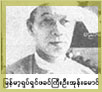
| In the year 1914, the spreading of the world's motion picture over to Myanmar, exerted artistic influence on a young individual by the name of U Ohn Maung. He studied all available books and movies on the subject and familiarized himself with the technique of photographing and making still pictures into moving pictures. In 1919, he made the very first Myanmar documentary film which was subject to the Myanmar Export and Traditional cottage industries such as Lacquer ware industry, Bassein parasol industry, Mandalay silk textile industry, etc. |
 |
| This film was only for the British Empire Exhibition, which was held in London, and it was not publicly screened in Myanmar. The first Myanmar documentary film to be publicly screened was made on the funeral procession of U Tun Shein, one of the Myanmar's delegates to the conference held in London, on 2d June 1920. In September 1920, this documentary was screened with an American full length feature film and the Myanmar audience gave tremendous encouragement.
The first Myanmar feature film "Myittar and Thuyar" was screened at the "Cine'ma de Paris" in Yangon on 6th November 1920 but it was a silent movie. The first Myanmar talkie films were publicly screened in late April 1932. The years 1942 to 1945 may be called the Myanmar movie industry's period during the World War II. During World War II, the Japanese Government invited Myanmar Leaders to Tokyo and held a ceremony in which Myanmar leaders were with Orders of the Rising Sun and Sashes. The Japanese Government filmed this ceremony and their arrival in Yangon, which was welcomed by Myanmar people in accordance with the conduct of Dr. Ba Maw's administration. It was the only film, which was made during the war. The British Government returned to Myanmar and resumed administration in 1946. The British Government formed the Board of Film Censors and it was the first governmental organization for the Myanmar Movie Industry. The first nongovernmental organization for the Myanmar Movie Industry was formed on 8th March 1946. The proprietors of motion picture and theatrical companies, together with performing artistes formed "The Myanmar Naing Ngan Motion Picture and Theatrical Asiayone". Myanmar became independent on 4d' January 1948. The British Government handed over the administration to Burmese leaders including General Aung San and U Nu. The Myanmar Government formed an organization to promote knowledge of film making on 1St June 1951. A sum of 4 million kyats was allotted to this organization for the purchasing of machinery and equipment and 1.2 million kyats was provided in cash as capital. It produced one black and white documentary film entitled. "Our Union". Later, the Buddha Sasana Foundation paid a sum of kyats 0.3 million to produce a colour documentary film on the "Sixth Buddhist Synonage". It was the very first colour movie for Myanmar movie industry. In November 1951, the Information Department of the Government of Myanmar constituted the "Union of Myanmar Motion Picture Scrutinization Committee was to develop the standard of domestic movie and also to prescribe rules and regulations for foreign movies. The annual Motion Picture Academy Awards were instituted by this committee. 1950's and early 60's were the golden years of Myanmar motion picture industry. It produced about 80 movies a year and some were joint production with foreign firms. Most of them were located in Myanmar but some were located in abroad and some were supervised by foreign technicians. In these days each cine'ma changed a movie on each Saturday and screened two shows on weekday. On Saturdays and Sundays there was an additional show at 3:30 pm. Some people realized that much monetary profit could be derived in this business and film companies sprouted like mushrooms. In proportion to the progress achieved by the companies, the actors, actresses and other performers were made salaried workers and trained them on job. The number of movie performers increased gradually. In 1962, the Revolutionary Council came to power. Since the national policy being based on socialist ideology, the people in power were determined to utilize all forms of media, including motion pictures and artistes, as tool for their propaganda purpose. The Government formed two organizations for Motion Picture Industry. 1. The Motion Picture Corporation (M.P.C) which was the state organization and 2. The Film Council (F.C) which was the non- government organization. The Government nationalized all the cinema halls and the Motion Picture Corporation (M.P.C) runs the distribution sector. The Film Council (F.C) runs the production sector. The main responsibility of these organizations was to keep a close watch on the activities of directors, actors, actresses, artistes and producers and to see that their professional performances were within the regulations laid down by the government and in The Film Council had to act as liaison between the private sector and M.P.C because M.P.C controlled not only the distribution sector but also the import of celluloid films for the films makers. |
|



Copyright © 2009 All Right Reserved by MYANMAR MOVIES. Prepared by DPS. Developed by PTTA (29 Aug 2009)